 Free Palm Reading
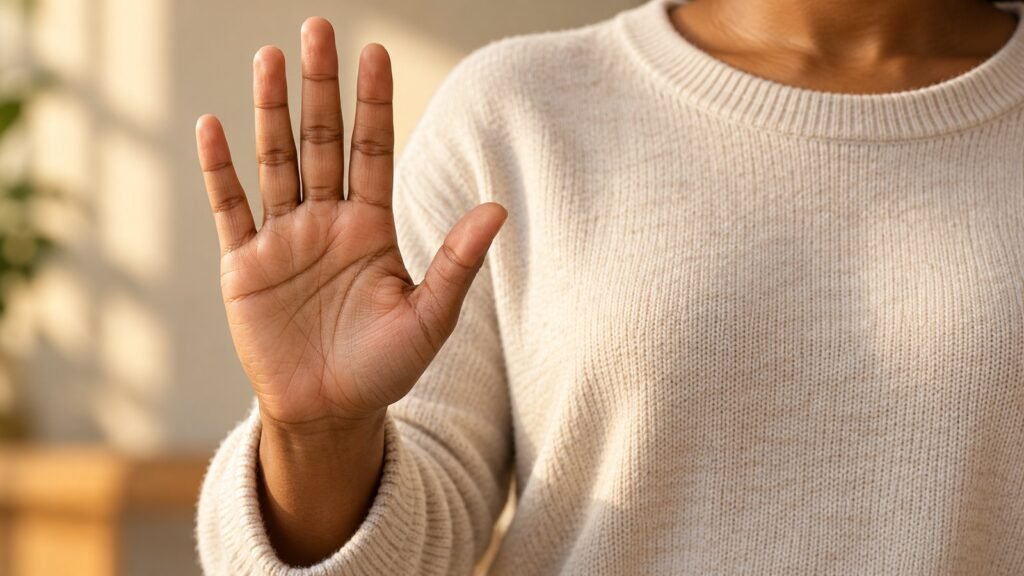
Palmistry can be explored as folklore and a creative conversation activity. A hand’s creases and shape do not establish someone’s personality, honesty, health, lifespan, or future. This exercise keeps what you can actually observe separate from the stories a palmistry interpretation might suggest.
Start with a neutral observation sheet
Choose your own hand or ask permission before examining someone else’s. Use comfortable, even lighting and a relaxed palm. Do not stretch the fingers to force a particular shape or press hard to make a crease look deeper.
| Area | Observation to record | Conclusion to avoid |
|---|---|---|
| Overall outline | Describe the palm and finger proportions in ordinary words. | “This proves I am a particular personality type.” |
| Large creases | Sketch the visible paths without interpreting them. | “A short crease means a short life.” |
| Smaller markings | Note what is clear and what is uncertain. | “Every mark must have a hidden meaning.” |
| Raised areas | Describe location rather than rating a person’s character. | “This area reveals honesty or romantic behavior.” |
Use traditional names as labels
Palmistry guides often call the upper large crease the “heart line,” the central one the “head line,” and the curve around the thumb area the “life line.” These are conventional reading labels, not medical descriptions or proven measurements of emotions, intelligence, or vitality. Individual hands may not match a simplified diagram neatly.
If you cannot confidently match a crease to a diagram, mark it uncertain. Do not invent a line to complete the illustration. The palm-line orientation guide can help you follow the vocabulary without treating it as a diagnosis.
Keep observation and symbolism in different columns
Try writing three separate statements:
- Observation: “I can see a crease curving around the base of my thumb.”
- Folklore label: “Some palmistry guides call this the life line.”
- Creative prompt: “What routines help me feel grounded?”
The third statement is a journaling question you choose. It is not information extracted from your hand. That distinction lets you enjoy the activity without confusing a story with evidence.
A short whole-hand activity
Set aside one page. Sketch the outline, add only the creases you can clearly see, and label uncertain areas with a question mark. Then choose one everyday topic you want to reflect on, such as a creative project or a friendship. Write a specific recent example about that topic before reading an interpretation.
Compare your own account with any symbolic description you encounter. Does the wording fit almost anyone? Would the opposite description also sound plausible? Can you name an experience that does not fit? You are allowed to reject the interpretation completely.
A fictional example
Sam writes, “I noticed several fine creases and a curved upper line.” A playful interpretation suggests creativity. Sam does not conclude that the hand proves artistic ability. Instead, Sam chooses the prompt “What would I like to make this month?” and decides to schedule a drawing session. The useful action comes from Sam’s interests and decision, not a prediction.
Respect boundaries in a group reading
- Ask whether the person wants to participate and accept a refusal.
- Let participants describe themselves rather than assigning labels.
- Avoid predictions about death, illness, fertility, infidelity, money, or disasters.
- Do not photograph or share someone’s palm without permission.
- End the activity if an interpretation causes distress.
For a structured alternative, use the reflection guide. If you try an automated reading, treat the output as generated entertainment that can be wrong. Read the privacy policy before uploading an image, and do not use a palm reading to make health, legal, financial, or relationship decisions.