 Free Palm Reading
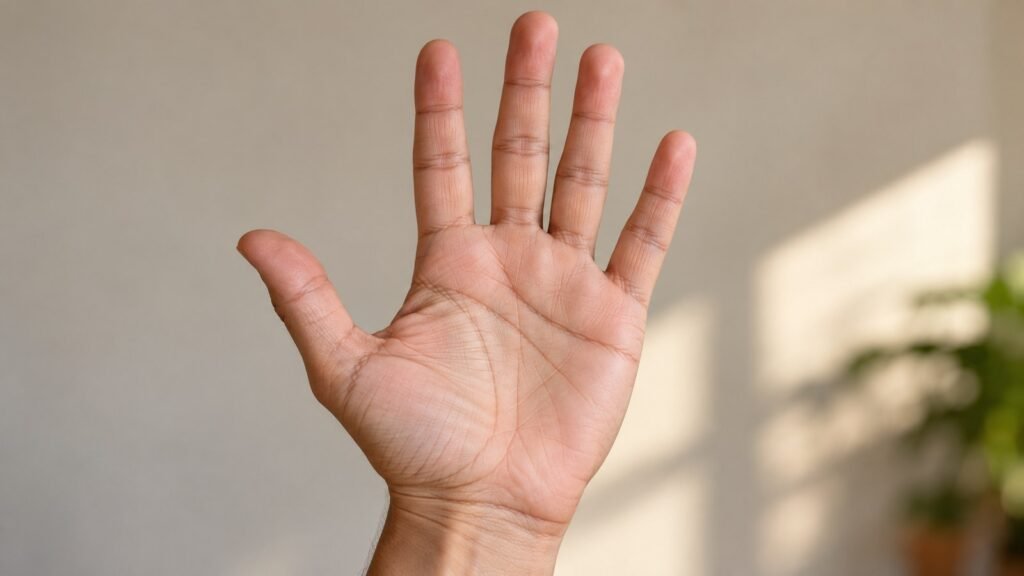
Start by describing what you can see, not by assigning a meaning. Palmistry uses names such as heart, head and life line for certain palm creases. The names belong to an interpretive tradition; they do not make a crease a medical test or a prediction.
Set up a clear observation
Place an open, relaxed hand under even light. Keep the whole palm visible, including the finger bases, thumb pad and wrist edge. Do not force your fingers apart or stretch a joint to make a line look deeper. Compare the original view with the photo: a shadow, glare patch or fold can look like a line in a small image.
Use an ordinary description first: “a curved crease beside the thumb pad” or “a transverse crease under the finger bases.” If you cannot distinguish a feature, write “unclear.” You do not need to invent a line to complete a diagram.
Use landmarks rather than a rigid template
| Palmistry name | Usual visual landmark | What to avoid assuming |
|---|---|---|
| Heart line | An upper transverse crease below the bases of the fingers | That it reveals another person’s feelings or relationship status |
| Head line | A crease crossing the central palm, below the upper transverse crease | That its shape measures intelligence or diagnoses a condition |
| Life line | A crease curving around the thumb pad, often beginning near the space between thumb and index finger | That length, gaps or depth predict lifespan or health |
| Fate line | A more vertical crease that some palmistry systems trace toward the middle-finger area | That everyone must have one or that its absence means failure |
These are orientation descriptions, not universal anatomical boundaries. Creases can vary, join, branch, be faint or be difficult to identify in a photograph. Do not label wrist creases as the heart, head and sun lines simply to fit a story.
A life-line check without lifespan myths
Find the thumb pad and look for the crease that curves around it. Trace only the part you can see clearly. Keep observations such as “faint in the photo” separate from interpretations such as “low energy.” A photograph cannot establish the second claim. A short, interrupted or unclear line does not justify a forecast about death or illness.
Keep two columns in your notes
In the first column, record the visible feature and uncertainty. In the second, write a traditional association and name its source. For example: “a curve is visible; the far end is obscured” is an observation. “This author associates the curve with warmth” describes that author’s symbolism. Neither entry establishes a factual personality finding.
A ten-minute exercise
- Spend two minutes identifying the thumb pad and finger bases.
- Choose one clearly visible crease and describe its route.
- Compare your description with a traditional diagram, noting differences instead of forcing a match.
- Write down one uncertainty caused by the photo or the diagram.
- If you want a reflective prompt, ask an open question about your actual experience rather than predicting an event.
Read historical diagrams critically
Cheiro’s Palmistry for All provides a historical example of palmistry classifications. The National Library of Medicine’s historical-collections article discusses older palmistry books and illustrations. These sources document traditions, not proof that the interpretations predict outcomes.
For using an interpretation constructively, read the observation and reflection worksheet. Before uploading an image to the AI reader, review how photos are processed and retained.