 Free Palm Reading
Palm reading terminology describes the lines, raised areas, shapes, and patterns that palmists observe. Learning the vocabulary helps you follow a reading and ask better questions. The key distinction is between a visible feature and its traditional symbolic meaning: a crease is observable, while its interpretation belongs to a particular palmistry system.
Start with these five palm reading terms
You do not need to memorize an entire dictionary before looking at your palm. Begin with the words that explain what a reader is actually doing. Keep a notebook nearby and write down descriptions before interpretations. This simple habit makes a reading easier to understand and prevents an unfamiliar label from sounding more certain than it is.
- Palmistry: the broad practice of interpreting hands through traditional symbolic systems.
- Chiromancy: a term often used for palm reading, especially interpretation of palm lines.
- Chirognomy: a term used in some books for studying hand shape, fingers, and other features rather than concentrating on lines.
- Observation: a description you can check, such as a crease curving around the thumb.
- Interpretation: the meaning a reader associates with that observation, such as a theme of personal direction.
Different authors use these terms somewhat differently. Ask which system a guide follows instead of assuming every book shares one vocabulary. You can enjoy a symbolic interpretation without treating it as a measurement of personality or a prediction.
The main palm lines: names and locations
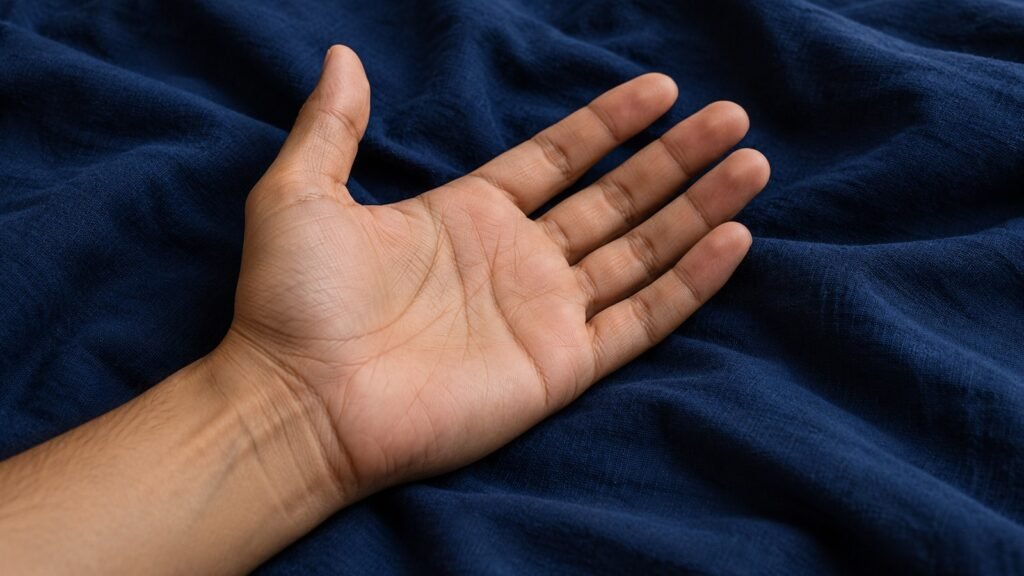
Look at an open, comfortably relaxed palm with the fingers pointing upward. Identify the larger creases first. Smaller branches can wait. The following locations are orientation cues, not a requirement that every hand must match a diagram exactly.
| Term | Where to look | Traditional theme |
|---|---|---|
| Heart line | The upper palm below the fingers | Emotional expression and relationships |
| Head line | A crease crossing the middle region of the palm | Thinking and approaches to decisions |
| Life line | A curve around the base of the thumb | Life journey and vitality symbolism |
| Fate line | A line traveling upward through the palm toward the middle finger | Direction and responsibility |
| Sun line | A line oriented toward the ring finger | Creativity and recognition |
The head line does not measure intelligence. The life line does not tell you how long you will live. A faint or absent fate or sun line does not mean someone lacks purpose or talent. These are names within a tradition, not verdicts about a person’s life.
When a guide says a line is deep, faint, curved, or straight, it is describing appearance. Lighting and hand position can affect that appearance, so check again before deciding what you see.
Mounts and hand shapes: the larger map
A mount is a named raised region used in palmistry maps. Several names come from planetary symbolism. They do not mean that a planet has been shown to control that part of your hand. The Mount of Venus is at the base of the thumb; Jupiter, Saturn, Apollo, and Mercury are associated with the areas beneath the index, middle, ring, and little fingers respectively. The Moon mount is along the lower outer side of the palm, opposite the thumb.
Start by finding each location rather than deciding whether it is unusually prominent. Pressure, camera angle, and the position of your fingers can change how raised an area looks.
Hand type describes a classification based on proportions. A common four-element system uses Earth, Air, Fire, and Water labels. Other books describe seven types or mixed types. These systems are not interchangeable scientific personality tests. If your hand seems to fit more than one description, record the proportions you observe and leave the label open.
Branches, breaks, islands, and other patterns
A branch is a smaller line extending from another line. A fork is a visible division into two directions. A break describes an apparent gap. An island is a small enclosed, elongated shape formed where a line separates and rejoins. A chain describes a sequence of small linked-looking patterns.
A cross involves intersecting lines. A star usually refers to several intersecting strokes. A square or triangle describes a shape that appears enclosed by lines. These words can sound precise even when a tiny mark is difficult to identify.
Do not start with the most dramatic label. First ask whether the pattern is genuinely visible, whether an unrelated crease crosses it, and whether it remains visible under softer light. There is no need to assign a meaning to every small mark. A useful reading can acknowledge that a feature is unclear.
Dominant and non-dominant hands
Your dominant hand is generally the hand you favor for skilled everyday tasks. Your non-dominant hand is the other one. Some palmistry schools call them active and passive hands, or associate them with lived experience and potential. Those associations are interpretive conventions rather than biological facts.
Left-handed readers do not need to reverse their identity to fit a right-hand diagram. If you use different hands for different tasks, simply describe that. When comparing palms, use the same lighting and a similar relaxed position. Write down which hand each observation belongs to. Differences are something to explore, not proof that one hand shows a better future.
A fictional example: translating a reading into plain English
Imagine Maya, a fictional beginner, reading the phrase “a forked head line on the dominant hand.” She first identifies the hand she normally writes with. Next, she looks for the crease across the middle of her palm. She notices a small division near its outer end, but checks a second photo to make sure the apparent fork is not another crease passing across it.
A traditional reader might connect that pattern with more than one approach to a problem. Maya does not conclude that the mark proves she has a special ability. Instead, she asks a useful question: “When do I benefit from considering both a practical solution and a creative one?” She writes down one situation where she could try that this week. The observation stays modest; the next step becomes personal and useful.
Practice the vocabulary in three simple steps
- Name one feature. Choose a major crease or a mount you can locate confidently.
- Describe it neutrally. Write “a curved line near the thumb” before adding a symbolic interpretation.
- Ask one reflective question. Choose a question that helps you consider an action, preference, or conversation.
Avoid memorizing frightening predictions, forcing your hand into an uncomfortable position, or treating a diagram as a standard everyone must meet. If you practice with a friend, ask permission and let them decide what they want to discuss.
Ready to see how the vocabulary appears in a personalized interpretation? Try a free palm reading on FreePalmReading.io, then return to your notes and separate what was observed from what was suggested.
Frequently asked questions about palm reading terms
Are the heart line and the marriage lines the same?
No. The heart line generally refers to a larger crease below the fingers. Marriage, union, or relationship lines are names used for smaller marks near the outer edge below the little finger. They cannot reliably count future marriages.
Does every palm have all the lines in a diagram?
No. Some lines are faint, difficult to distinguish, or not visible. Diagrams simplify the subject for teaching. A missing line does not establish a missing quality in the person.
Why do two books give different meanings for one term?
Palmistry contains different schools and historical conventions. Check each author’s definitions and hand map before combining interpretations. It is reasonable to record the disagreement rather than deciding one rule must fit everyone.
What is the best term to learn first?
Start with observation. Learning to describe what you can actually see gives you a steadier foundation than collecting meanings for rare signs. Then learn the three main line names and a few mount locations.
Further reading and your next step
Cheiro’s Palmistry for All is a historical primary source for many familiar English-language terms. Read its interpretations as period beliefs; its confident claims are not proof of prediction. The National Library of Medicine’s overview of historical palmistry books shows how diagrams and labels changed between editions.
Choose three terms from this guide and locate them on your own palm. Keep your descriptions simple, stay curious, and finish with one encouraging question you can act on. You do not need an expert vocabulary to begin a thoughtful conversation about yourself.
See what your own palm inspires
Choose your reading type and upload a clear palm photo for an encouraging interpretation.
Explore more palm reading and palmistry guides.