 Free Palm Reading
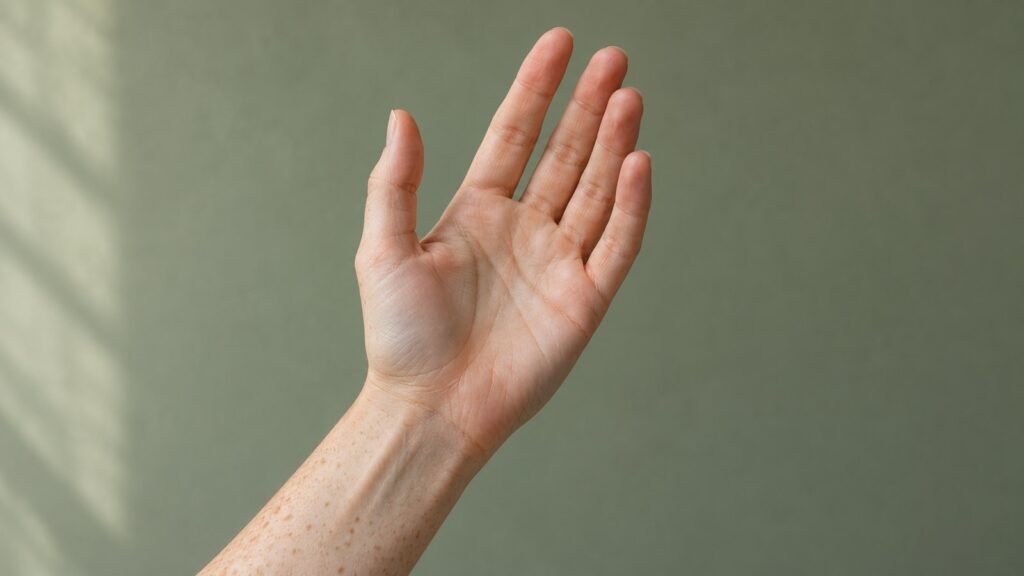
The Head Line in palmistry traditionally symbolizes an individual’s style of thinking and approach to processing information. A straight Head Line suggests a practical, logical thinking pattern focused on clarity and realism, while a sloping Head Line is said to reflect a more imaginative, intuitive, or creative mindset. These interpretations come from long-standing symbolism rather than established facts about personality or intelligence.
Observing the Head Line: Straight vs. Sloping
The Head Line runs horizontally across the palm, typically starting near the edge of the palm between the thumb and index finger, extending across toward the opposite side. To distinguish a straight Head Line from a sloping one, observe its angle carefully:
- Straight Head Line: This line generally runs almost parallel to the bottom edge of the palm, maintaining a horizontal path with little to no downward slope.
- Sloping Head Line: This line inclines downward as it moves across the palm, slanting toward the base of the fingers or the wrist.
Keep in mind, palms vary widely, and the difference between a steeply sloping line and a slightly curved one can be subtle. Lighting and hand position may also affect perception. Use consistent natural light and view the hand palm-up on a flat surface. Comparing both palms can reveal if the pattern is consistent or varies between hands.
Traditional Symbolism of a Straight Head Line
In palmistry tradition, a straight Head Line is believed to symbolize a clear, methodical style of thinking. Those with this line are thought to prefer logic, practical reasoning, and structured decision-making. They are associated with an analytical outlook and a capacity to focus closely on details without distraction.
This symbolism suggests a preference for facts and straightforward problem solving rather than emotional or imaginative approaches. A straight Head Line may be considered a sign of someone who values realism and predictable outcomes over experimentation or risks.
It is important to emphasize that this is a traditional symbolic interpretation within the palmistry system, not a psychological or neurological diagnosis. The line’s shape historically offered a reflective mirror for perceived mental habits, not a proven measurement of any cognitive skill or trait.
Traditional Symbolism of a Sloping Head Line
The sloping Head Line is traditionally linked with imagination, creativity, and an intuitive way of thinking. Palmistry lore suggests that a downward-sloping Head Line may indicate a person who processes information emotionally or artistically rather than purely logically.
This line style often symbolizes a mind that enjoys daydreaming, brainstorming, and exploring abstract or unconventional ideas. Such individuals may be seen as innovative, flexible thinkers who are inclined to trust instincts or feelings.
Again, this symbolism is a cultural tradition rather than scientific fact, reflecting historical beliefs about character traits associated with certain line patterns. The sloping Head Line does not guarantee creativity or intuition, only symbolizes these qualities as part of classic chiromantic interpretation.
Nuance and Variations: What If Your Head Line Is Neither Fully Straight Nor Steeply Sloping?
Many readers will find lines that are neither fully straight nor strongly sloping but somewhere in between, or curved gently. Palm lines often have unique irregularities such as breaks, forks, or wavy sections, complicating neat categorization.
Such variations may be seen as blends of symbolic qualities—one part practicality and one part imagination—suggesting a flexible or versatile thinking style according to palmistry tradition. Lines that begin straight and end sloping may indicate changes over time in a person’s thinking approach.
A curved Head Line gently dipping downward might be interpreted as a balanced thinker: grounded but open to intuition or creativity. Some palm readers consider the line’s length, depth, and clarity alongside its angle to provide a fuller symbolic picture.
It’s useful to approach these gradations as prompts for reflection, not fixed labels. The diversity of line forms encourages curiosity rather than certainty.
Step-by-Step Method to Observe Your Head Line Accurately
- Prepare: Place your palm facing upwards under natural light on a flat surface to reduce shadows and distortion.
- Identify: Locate the Head Line as the horizontal crease below the topmost line (Heart Line).
- Angle assessment: Visualize or lightly mark if the line runs horizontally or slopes downwards noticeably.
- Compare hands: Check if both palms have similar style lines or differ—variation between hands is common.
- Record: Note if the line is straight, sloping, curved, interrupted, or forked for future observation.
This method helps avoid misjudging line angle due to perspective or lighting errors. Using photo documentation at a 90-degree angle also assists clarity. Remember that hands may change subtly over time, affecting line appearance.
Common Mistakes When Reading the Head Line
- Confusing adjacent lines: The Head Line often lies close to the Heart Line. Mixing these lines leads to inaccurate symbolism.
- Ignoring line breaks: Breaks or forks can change the meaning traditionally but are often overlooked.
- Overanalyzing depth: While some palms have deeply etched lines, depth should not be confused with validity of symbolic meaning. It can be a skin characteristic.
- Forcing a label: Trying to classify a line as purely straight or sloping when it has nuances can discard useful interpretation opportunities.
These mistakes stem from rushing or misunderstanding palm line structures. Careful, patient observation yields more thoughtful symbolic insights.
Fictional Example
Imagine Emma, a graphic designer, who on observing her dominant right hand notices her Head Line begins nearly straight below her index finger but gradually slopes downward before ending near the middle of her palm. Emma recalls that traditional palmistry associates a straight Head Line with practicality and a sloping one with creativity.
Emma reflects on her own thinking style: she enjoys solving client problems with a structured approach yet often switches to intuitive, experimental design ideas mid-project. Her Head Line’s mixed form symbolically captures this blend. She also notices her left hand has a more pronounced sloping line, suggesting her non-dominant hand reflects a freer, more imaginative mindset.
Using this traditional symbolism, Emma considers how she balances logic and creativity in her daily work without assuming fixed personality traits. This reflection encourages her to embrace both sides of her thinking style rather than feeling boxed into one category.
Comparison Table: Straight Head Line vs. Sloping Head Line
| Aspect | Straight Head Line | Sloping Head Line |
|---|---|---|
| Line Direction | Runs nearly horizontal, parallel to palm base | Slants downward across palm toward wrist or base of fingers |
| Traditional Thought Style | Logical, practical, focused on facts | Imaginative, intuitive, creative |
| Decision Approach | Methodical, structured | Flexible, emotional or artistic |
| Symbolic Suggestion | Clear mental clarity and realism | Open to abstract and innovative ideas |
Practical Exercise and Actionable Takeaways
- Examine your own Head Lines: Use natural light and follow the step-by-step method to note the angle and characteristics.
- Journal your thoughts: Reflect on whether the symbolism resonates with your thinking preferences or prompts useful self-awareness.
- Compare changes over time: Take photos monthly—notice if your perception or line appearance shifts, encouraging ongoing curiosity rather than fixed conclusions.
For further exploration of your palm lines, visit free palm reading at FreePalmReading.io, where you can learn more about how to interpret your lines thoughtfully and enjoyably.
Frequently Asked Questions
Does a straight or sloping Head Line predict intelligence?
No. Traditional palmistry symbolism associates line shape with thinking style, not intelligence. The lines are not reliable measures of IQ or cognitive ability.
Can my Head Line change over time?
Yes, palms can evolve subtly due to skin changes or life experiences. Changes in the Head Line symbolic style may prompt reflection but do not indicate fixed mental traits.
What if my Head Line is broken or forked?
Breaks or forks in the Head Line add nuance in traditional symbolism, suggesting variability or complexity in thinking. However, these are interpretive symbols without scientific basis.
Should I read both hands or just one?
Reading both palms provides a fuller traditional symbolic view since lines can differ between hands. This dual observation highlights personal agency and complexity.
Conclusion
Exploring the differences between a straight and sloping Head Line offers engaging symbolic insight into thinking styles rooted in palmistry tradition. While a straight line evokes practical and logical thought, and a sloping line suggests imagination and creativity, these are merely historical concepts for reflection rather than established facts. Observing your own lines with care can inspire self-understanding and curiosity about how you approach challenges and ideas. Embrace the complexity and variety of your palm lines as a creative mirror—not as a fixed label. Enjoy your exploration, and remember that your thinking style is an evolving, personal process beyond the lines on your hands.
Further Reading
- Cheiro’s Palmistry for All – A classical text describing traditional palm line symbolism and interpretations.
- NLM’s Historical Overview of Palmistry – Contextual background on palmistry as entertainment and cultural belief.
See what your own palm inspires
Bring these ideas to life with a reading focused on you. Choose a reading type and upload a clear palm photo to explore an encouraging interpretation.
Explore more palm reading and palmistry guides.