 Free Palm Reading
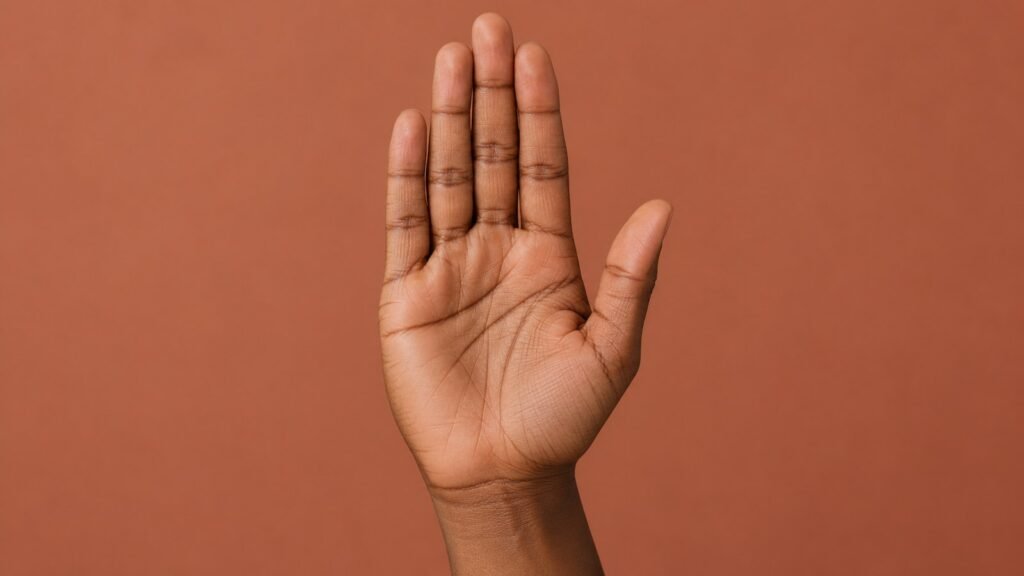
A palm-reading reflection worksheet
Palmistry can be a storytelling prompt. It cannot establish your personality, predict your income, diagnose a condition, or decide whether someone is a suitable partner. This worksheet turns traditional labels into questions you can answer from your own experience. Your answers matter more than the shape of a crease.
Start with observation
Choose a comfortable hand position and ordinary light. Describe what you can actually see: a curved crease, a faint section, or a line partly hidden by glare. Do not turn an uncertain photograph into a confident conclusion. Consult our main palm-lines guide for orientation, and leave a label blank if it does not fit your hand.
Separate a symbol from a claim
| Traditional theme | Useful reflection question | What a hand cannot establish |
|---|---|---|
| Heart line: relationships | What helps me communicate a need clearly? | Compatibility, fidelity, or another person’s feelings |
| Head line: thinking | When did I last change my mind after learning something? | Intelligence or a mental-health diagnosis |
| Life line: personal story | Which routines give my week structure? | Lifespan, illness, or a date of death |
| Fate line: direction | What is one small step toward a goal I chose? | A guaranteed career or future event |
| Sun line: creativity | What would I enjoy making without an audience? | Fame or financial success |
A ten-minute practice
- Two minutes: write three neutral observations about your hand. Avoid words such as lucky, unhealthy, successful, or destined.
- Three minutes: pick one theme from the table. Answer its question using a real example from your life.
- Three minutes: write a second explanation for the same experience. A convincing reading can feel personal even when its language applies to many people.
- Two minutes: choose an action you can evaluate independently, such as asking a clear question, scheduling practice, or comparing actual course requirements.
Worked example: a career question
Observation: “I cannot see a clear vertical crease in the middle of this photo.” A traditional reading might discuss the fate line, but the missing crease does not mean you lack purpose. A better question is: “Which task did I enjoy this week, and which skill would help me do more of it?” An action could be comparing two training options by cost, time, and entry requirements. Check the result against real evidence rather than looking for confirmation in the photograph.
Use relationship prompts with consent
If you try this with a friend, invite them to answer their own questions. Do not label them as unfaithful, emotionally unavailable, or a poor match based on a hand. Do not upload somebody else’s photograph without permission. A playful exercise should not become a test another person has to pass.
Keep the useful part, question the rest
After a week, ask whether your chosen action helped. You do not need to accept the interpretation to benefit from journaling. If the exercise causes worry, stop. For health, legal, financial, or other consequential decisions, use qualified guidance and reliable evidence.
This is an editorial exercise, not a clinical assessment or a customer testimonial. For background, see the National Library of Medicine’s historical discussion of palmistry. Read our editorial standards and photo privacy policy before using the AI reader.