 Free Palm Reading
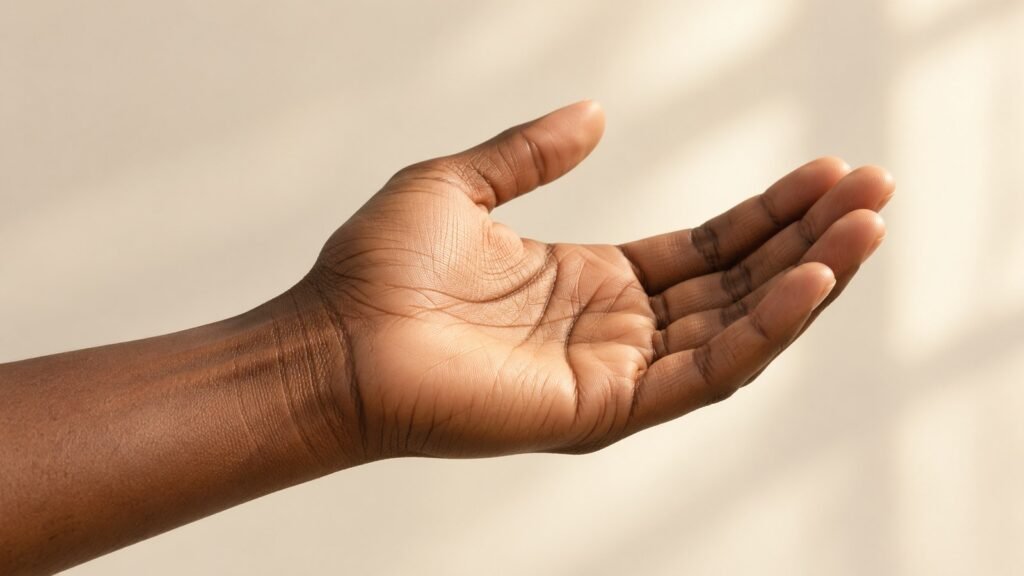
Editorial note: Palmistry is entertainment and folklore. A palm photo does not establish health, lifespan, personality, fidelity, or future events. The exercises below separate visual observations from optional creative themes.
Some palmistry descriptions associate a long “heart line” with emotional themes. These are folklore claims, not measurements of a person’s capacity to care. If you are curious about what a long Heart Line might symbolically suggest about emotional themes, this guide will help you observe your own or another’s hand with care, reflect critically on the meaning, and use that insight as a tool for understanding emotional communication and boundaries—not for predicting or judging personality.
What Does a Long Heart Line Look Like?
The Heart Line generally runs horizontally across the top of the palm, below the fingers. A long Heart Line extends well past the middle of the palm, sometimes reaching under the index finger or even the middle finger. Its length often covers most of the upper palm, sometimes spanning nearly from the edge below the pinky finger toward the edge below the index finger.
Why Focus on Length?
Traditionally, the length of the Heart Line is associated with the scale of emotional experience or involvement. Longer lines are said to suggest a stronger capacity for caring, emotional complexity, or a wide range of emotional encounters.
Task: Observe and Reflect on a Long Heart Line to Understand Emotional Themes
This task is about using the traditional theme of a long Heart Line as a prompt to explore your real experiences with emotional expression, limits, and connection. Instead of taking the line as a fixed fact, you will observe it, note details, and reflect on what it might symbolically remind you to consider or understand about emotional communication.
Step 1: Visual Observation
- Look closely at the Heart Line on your palm or a willing friend’s palm under good light.
- Check how far it extends across the palm. Does it reach under the index finger? The middle finger? Does it curve up or stay mostly straight?
- Notice the line’s depth (is it clear and strong or faint?), breaks, forks, or unusual marks. These details matter in tradition but also as visual prompts for reflection.
Step 2: Record Your Observations with a Worksheet
| Feature | Details |
|---|---|
| Length of Heart Line | e.g., Reaches under index finger |
| Curve Direction | Curves upward toward middle finger |
| Line Strength | Strong, clear line |
| Breaks or Forks | Forks near index finger end |
Use these details not to label personality traits but as cues for guided reflection.
Step 3: Guided Questions to Explore Emotional Themes
- How do you usually express your emotions to others? Do you feel you have a wide emotional range or depth?
- Are you comfortable with emotional boundaries, or do you find yourself overwhelmed by connection?
- Does the way the line curves or forks resonate with moments when your emotions twist, change direction, or split between conflicting feelings?
- Consider a time when expressing care or affection was complex. How might that relate to the breadth suggested by the long line?
Hypothetical Example
Suppose Anna’s Heart Line extends fully beneath her middle finger, with a clear fork just before it ends. Rather than assuming this means she is automatically “emotional” in a certain way, Anna uses these observations to remember how she experiences relationships: often deeply caring (long line) but sometimes torn between what she feels and what she allows herself to express (forked end). This prompts her to reflect on balancing emotional openness with healthy boundaries.
Quick Comparison: Long Heart Line vs. Short Heart Line
| Feature | Long Heart Line (Traditional) | Short Heart Line (Traditional) |
|---|---|---|
| Emotional Expression | Wide range, strong intensity | More reserved, selective |
| Relationship Focus | Emphasis on deep or many connections | Emphasis on a few close bonds |
| Emotional Boundaries | May challenge boundaries due to intensity | Often clearer or tighter boundaries |
Note: These traditional associations are only symbolic themes, not predictive personality profiles.
Why These Choices Matter
Focusing on close observation with reflection rather than assumptions respects the complexity of human emotion. The length of the Heart Line can inspire awareness about emotional patterns but must not be seen as final or exclusive. By using details from the line, a reader can create a personal, practical conversation about emotional communication rather than a static judgment.
What to Do Next
- Photograph your palm from above, ensuring the Heart Line is clear and well-lit.
- Use the observation worksheet to note features without rushing to conclusions.
- Reflect using the question list as journal prompts or discussion starters with a trusted friend.
- Keep visual observations separate from personal experiences; do not infer emotional changes from differences between palms.
- Remember to treat the reading as a tool for self-exploration, not prediction or personality labeling.
Brief Troubleshooting if Observation is Difficult
- Line is faint: Use even light and mark uncertainty in a separate sketch; do not draw a feature onto the hand or original photo and then treat it as observed evidence.
- Line is broken or unclear: Note breaks as part of the reflective prompt—consider times of emotional transition or conflict.
- Uncertainty about exact line start/end: Use the palm anatomy guide at here for clarification.
FAQs
- Does a long Heart Line mean someone is overly emotional?
- No. A long Heart Line traditionally symbolizes a capacity for a wide emotional range and depth but does not diagnose or guarantee how a person feels or behaves emotionally.
- Can the Heart Line change over time?
- Photographs can look different with changes in lighting, focus, pose, and angle. A difference between two pictures does not establish an emotional change or life event.
- Is a forked Heart Line always a sign of emotional conflict?
- Traditionally, forks can indicate branching emotions or choices but are best used as metaphors for personal reflection, not literal emotional states.
Prepared with AI assistance for education, observation and entertainment. Palmistry does not predict outcomes or provide professional advice.