 Free Palm Reading
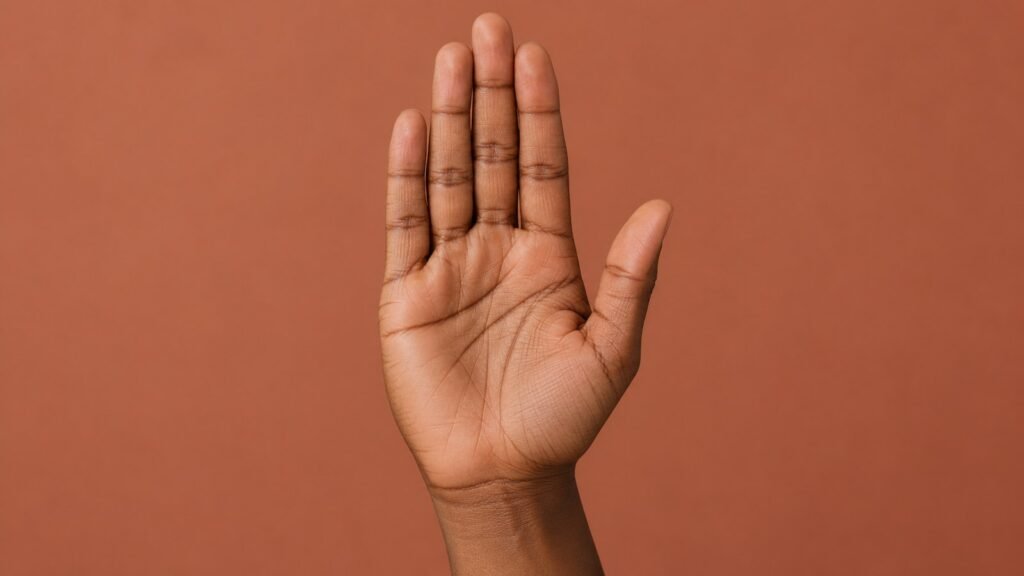
The heart line on your palm, traditionally considered a symbol of emotional tendencies, can appear as either curved or straight. A curved heart line often reflects warmth and expressiveness in emotional life, while a straight heart line is associated with a more reserved or controlled emotional nature. These interpretations are traditional symbolism, meant for reflection rather than firm conclusions about one’s feelings or relationships.
Understanding the Heart Line: Basic Observation
The heart line is the horizontal line located near the top of your palm, starting under the pinky and extending towards the index finger or middle finger. When observing it, note its shape: is it gently curved, flowing smoothly along the hand’s contour, or mostly straight, running in a firm, horizontal line? Pay attention to where it begins and ends, and whether the curve is slight or pronounced.
Careful observation requires good lighting and a relaxed hand position, ideally flat and open. Avoid confusing the heart line with adjacent lines such as the head line below it or smaller creases near the fingers. Remember, hand size, skin texture, and finger positioning can affect line appearance, so consider variability when observing your own or others’ palms.
It helps to view the heart line from the same angle repeatedly, noting any changes in curve or flow. If uncertain, trace the line lightly with a finger or pencil to feel its path tactilely, which can aid in distinguishing subtle curves from straight sections.
Traditional Symbolism of a Curved Heart Line
Traditionally, a curved heart line is believed to symbolize a person who is emotionally warm, open, and expressive. The curvature suggests fluid feelings and a natural tendency to share emotions. In palmistry lore, this line shape represents empathy and an affectionate approach to relationships.
Such a heart line is thought to indicate emotional flexibility and a capacity to connect warmly with others, emphasizing heartfelt experiences rather than detachment. It may suggest that the person values emotional expression as part of their identity, reflecting kindness or a nurturing spirit.
However, this symbolism is not a fixed trait or diagnosis. The curve’s degree and flow vary widely among individuals, and it may reflect momentary mood or general attitude in traditional belief rather than an unchanging personality trait.
Traditional Symbolism of a Straight Heart Line
A straight heart line is commonly interpreted as representing emotional steadiness, self-control, and sometimes reserve. It often suggests an individual who prefers rationality in emotional matters, maintaining boundaries rather than overt emotional display.
Traditional readings associate a straight heart line with people who may approach relationships with caution or deliberation, emphasizing logic or duty over spontaneous emotional reaction. This line shape can symbolize practicality and clear emotional boundaries.
Yet, as with any palmistry symbolism, the straight heart line is not proof of emotional detachment or inflexibility—only a traditional emblem of a more grounded emotional character, subject to many exceptions and personal dynamics.
How to Differentiate Curved vs. Straight Heart Lines
To distinguish a curved from a straight heart line accurately, follow these steps:
- Locate the line: Find the topmost horizontal line starting below your pinky finger.
- Observe the shape: Look at the general flow—does it bow upward or run flat?
- Compare both hands: Many people have different heart lines on each hand, reflecting varied traditional readings.
- Note subtleties: Some heart lines start straight then curve; decide which shape dominates.
- Stay neutral: Observe without assigning meaning until comfortable with shapes.
Common mistakes include confusing the heart line with the head line beneath, or misreading minor creases as part of the heart line. Checking hand position and using natural light can prevent errors.
A Comparison Table: Curved vs Straight Heart Lines
| Aspect | Curved Heart Line | Straight Heart Line |
|---|---|---|
| Basic Shape | Arches upward gently or noticeably | Runs mostly horizontal without curve |
| Traditional Symbolism | Warmth, expressiveness, emotional openness | Emotional control, reservation, steadiness |
| Emotional Reflection | Suggests fluid, adaptable feelings | Indicates measured, deliberate emotional style |
| Common Misinterpretations | Mistaken for head line curvature | Sometimes confused with parallel minor creases |
| Variability | Often changes between hands or with age | Generally stable but can show subtle curves |
Fictional example: Reading Anna’s Heart Line
Anna examines her left palm and sees a heart line that gently curves upward, arching beneath her pinky and drifting toward her middle finger. It is well-defined and smooth, with no breaks, creating a flowing shape. On her right hand, the heart line appears straighter, running nearly horizontal from pinky to between index and middle finger.
Reflecting on traditional beliefs, Anna considers the curved heart line might symbolically represent her open and warm emotional expressions, especially in personal close relationships like family. The straight line on her other hand could indicate moments when she approaches emotions more cautiously or logically. She recognizes these interpretations as traditional symbolism to think about her feelings, not as fixed truths or predictions.
Anna feels encouraged to journal how her emotions vary in different situations, using her palms as a gentle mirror rather than a verdict, enhancing her self-reflection and emotional awareness with kindness and curiosity.
Common Mistakes When Observing the Heart Line
- Confusing the heart and head lines: The heart line lies closer to the fingers and is more horizontal, while the head line is below and often sharper in angle.
- Overemphasizing small creases or breaks: Minor lines do not alter the overall shape sufficient to redefine a heart line’s character.
- Ignoring hand position and lighting: Shadows and hand curves distort line appearance; always observe with flat, well-lit hands.
- Assuming meaning from handedness alone: Each hand may have different heart lines and traditional interpretations vary depending on whether one reads dominant or non-dominant hands.
Practical Exercise: Noticing Your Heart Line
Try this simple self-reflective exercise to connect with your heart line:
- Find a quiet spot: Sit comfortably and relax your hands.
- Look closely: Using natural light, hold one hand flat and find your heart line.
- Trace gently: Follow the line’s path with your finger.
- Note the shape: Is it mostly curved, straight, or a mix?
- Journal thoughts: Using the traditional symbolism as reflection prompts (e.g., “What does emotional warmth mean to me?”), write down your feelings related to this line.
This exercise encourages emotional self-awareness without fixed meaning. For more reading techniques, visit FreePalmReading.io’s reading steps.
FAQs About Curved and Straight Heart Lines
Does a curved heart line mean I am more loving?
Traditionally, a curved heart line suggests emotional openness and warmth, but this is symbolic rather than a literal guarantee of behavior. People express love in many ways that do not depend on palm lines.
Can my heart line change over time from straight to curved?
Yes, the heart line can subtly change with age, health, or skin changes. Such changes do not definitively alter who you are emotionally; they represent natural palm variations.
Is it common to have different heart lines on each hand?
Absolutely. Traditional palmistry often interprets the dominant and non-dominant hand differently, so having one curved and one straight heart line is quite normal and reflective of emotional complexity.
Should I rely on my heart line to understand my relationships?
Heart line interpretations are traditional symbols to reflect on emotions, not predictors of relationship outcomes. Personal awareness, communication, and choices are more reliable guides.
Conclusion: Reflecting with Curved and Straight Heart Lines
Your heart line is a unique aspect of your palm, rich with centuries of symbolic meaning but not a definitive script for your emotional life. Whether curved or straight, it serves as a gentle mirror inviting personal reflection and discovery. Embrace both shapes as ways to explore your feelings with kindness and curiosity, remembering that real emotional connection depends on your choices and openness, not your palm lines alone.
Use the heart line’s symbolism as a tool to enhance your self-awareness and empathy, not to confine or predict. For deeper exploration, FreePalmReading.io offers accessible guides to understand your palm lines as reflective entertainment and personal insight.
Further Reading
- Cheiro’s Palmistry for All – A historical primary text on traditional palm line meanings.
- The National Library of Medicine’s Palmistry in History – Context on chiromancy as entertainment and belief.
See what your own palm inspires
Bring these ideas to life with a reading focused on you. Choose a reading type and upload a clear palm photo to explore an encouraging interpretation.
Explore more palm reading and palmistry guides.