 Free Palm Reading
Learning beginner palmistry in four weeks requires focused observation, critical engagement with sources, and structured practice. This study plan guides you to gradually identify and document key palm features, understand their traditional symbolism, and apply thoughtful questions rather than accepting fixed meanings. By distinguishing observation from interpretation, you build a sustainable, reflective approach to palm reading as cultural entertainment.
Week 1: Observing Basic Palm Features and Shapes
Start by familiarizing yourself with the foundational elements of the hand. Observe the overall shape, size, and flexibility without jumping to conclusions. Identify the hand type, traditionally categorized into four classical forms—Earth, Air, Water, and Fire—based on palm shape and finger length. For example, an Earth hand is often square with thick fingers, symbolizing stability in traditional palmistry, while a Water hand is usually long and narrow, reflecting sensitivity.
Practice distinguishing the mounts—fleshy pads at the base of the fingers named after planets (Jupiter, Saturn, Apollo, Mercury). Note their size and prominence, as traditional palmists associate them with traits like ambition or creativity, but remember these are symbolic meanings rather than proven characteristics.
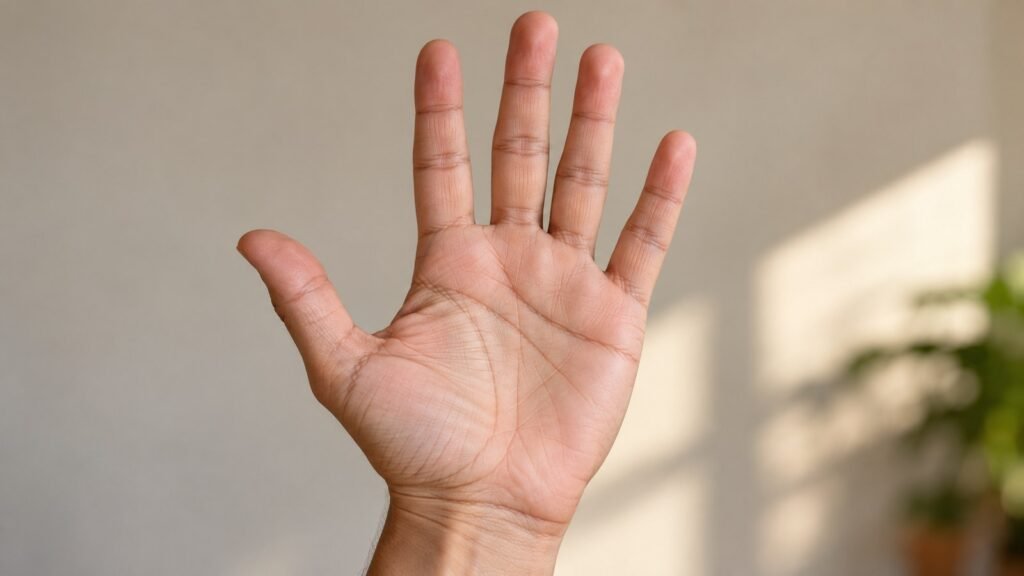
A practical step: take clear, well-lit photos of your own palm or a friend’s hand from different angles. Sketch the main contours and lines, noting differences between hands. Focus first on accurate visual recording before learning the symbolism to avoid bias.
Week 2: Learning the Major Lines—Life, Heart, and Head
This week centers on recognizing and describing the three primary palm lines, each rich in symbolic tradition but never literal truth. The Life Line curves around the thumb’s base, traditionally linked to vitality and life energy. The Heart Line runs beneath the fingers, associated with emotional matters, while the Head Line stretches across the palm and is said to relate to intellect.
Observe line length, depth, breaks, and intersections. For example, a deep Life Line might traditionally signify strong vitality, while a faint Heart Line can indicate reserved emotional expression. However, view these as traditional metaphors rather than facts about your health or personality.
Use nonjudgmental language—describe what you see clearly, such as “the Heart Line curves upward under the middle and index fingers”—instead of interpreting it immediately. Track differences in line clarity upon repeated observations since lighting and hand movement impact visibility. This habit trains your eyes to detail rather than assumption.
Week 3: Exploring Secondary Lines and Mounts
Expand your skills by identifying secondary lines like the Fate Line, Sun Line, and Mercury Line, as well as refining your understanding of mounts. The Fate Line, for example, runs from the middle of the palm toward the middle finger and traditionally is linked to career or life direction, though some hands lack it entirely without consequence.
Secondary lines can vary widely and often overlap or fade, making them challenging to pinpoint. Practice tracing these lines gently with a finger and a pen (without marking the skin) to improve recognition. This tactile approach helps separate confident observations from guesswork.
Pay close attention to mount features—swollen or flat areas below each finger—and note their relative prominence. Traditional symbolism assigns meanings such as the Mount of Venus representing love and sensuality. Always remember these associations are based on cultural tradition, not proven personality traits.
Week 4: Integrating Observations and Critical Reflection
In your final week, focus on synthesizing your anatomical observations with symbolic knowledge while maintaining a critical perspective. Practice making neutral statements first, e.g., “The Head Line splits into two branches near the center.” Then, if interested, you can mention traditional interpretations, such as saying this is often viewed as a sign of versatility in old palmistry texts.
Apply reflective questions: What meanings feel relevant or fun? Which seem arbitrary or inconsistent? Use journaling to document your observations and personal reactions to interpretations, noting when symbolism resonates or feels forced.
This step encourages balancing curiosity with skepticism, avoiding claims of fixed destiny or personality judgment. Palm reading is a cultural and creative tool, not a science. Continue practicing by comparing hands and reading diverse source materials, including historical texts from which many palmistry ideas originate.
Common Mistakes to Avoid When Learning Palmistry
Many beginners try to jump directly to personality labels or future predictions without thorough observation. Avoid assuming a line or mount “means” a specific trait without first confirming its presence and features clearly. Lighting, hand position, and even skin texture affect what you see.
Another common error is mixing unrelated systems or relying too much on modern internet memes about hand shapes. Remember, symbols vary between traditions and contexts. Stick with one source at a time and note cultural differences.
Finally, avoid using palm reading to make important decisions or judge others. Interpretations are for entertainment and self-reflection, not diagnostics or advice.
Fictional Example: Applying the Four-Week Plan
Imagine Emma, a curious beginner, decides to follow the four-week plan. In Week 1, she observes her own hands and notes she has a square palm with broad fingers, identifying them as an Earth hand shape, traditionally linked to practicality. She photographs her dominant right hand and sketches its contours, noting the prominent mounts below her fingers.
By Week 2, she clearly sees her Life Line curving strongly around the thumb, a deep Heart Line that ends below her middle finger, and a Head Line that is straight and crosses the palm horizontally. She records these without assigning fixed meanings, simply noting line length and curvature.
During Week 3, Emma detects a faint Fate Line running centrally up her palm, which some traditional sources associate with a defined career path. She also notes the Mount of Venus is notably full and rounded, reflecting a common symbolic link to warmth and vitality.
In Week 4, Emma reviews her notes and adds journal reflections, questioning how these interpretations resonate with her own self-view. She uses balanced language: “The Life Line is deep and curving, traditionally a sign of vitality but here simply a feature I observed.” Emma has moved beyond memorization into thoughtful exploration.
Practical Exercise and Actionable Tips
- Daily Observation: Spend 5 minutes each day examining one hand. Focus on one feature, such as the Heart Line, and note its shape, length, and breaks in detail.
- Use Neutral Descriptions: When journaling your observations, avoid applying symbolism immediately. Describe visuals matter-of-factly to build strong observational skills.
- Compare and Contrast: Look at different hands from friends or photos, noting how features differ. Ask whether symbolic meanings feel consistent or subjective, encouraging critical thinking.
For a guided start, visit the free palm reading steps at FreePalmReading.io’s reading step 1 to track your progress.
Comparison Table: Key Palm Features and Traditional Symbols
| Feature | What to Observe | Traditional Symbolism (Entertainment) |
|---|---|---|
| Life Line | Curvature, depth, breaks, length around thumb | Vitality and general life energy |
| Heart Line | Length, curvature, position under fingers | Emotions, love, and affection |
| Head Line | Direction, faintness, intersections | Intellect and thinking style |
| Fate Line | Presence, depth, origin point | Career path or life direction |
| Mount of Venus | Size and fullness under thumb | Passion and vitality |
| Hand Shape | Square vs. long, finger length | Character traits per four types (Earth, Air, Water, Fire) |
FAQs About Beginner Palmistry Study Plans
How do I know if I’m seeing the correct palm lines?
Focus on clear lighting and keep your hand relaxed and flat. Lines may appear faint or broken; tracing gently with a finger or soft pencil helps visualize them. Compare observations over multiple sessions to confirm consistency.
Can I trust the traditional meanings of palm lines and mounts?
Traditional meanings are symbolic and based on cultural beliefs, not scientific evidence. Use them as frameworks for exploration and self-reflection instead of factual personality or fate indicators.
Is it okay to use multiple palmistry sources when learning?
Yes, but approach all sources critically and understand that different traditions may disagree. Focus on learning to observe with clarity before adopting symbolic interpretations.
How often should I practice palm reading to improve?
Daily observation of a few minutes helps build skill steadily. Consistent practice with journaling and comparison deepens both your visual accuracy and your balanced understanding.
Conclusion: Embrace Curiosity with Critical Thinking
By following this four-week beginner palmistry study plan, you cultivate keen observation skills and an open, reflective mindset toward palm reading. Rooted in centuries of symbolic tradition but free from unfounded claims, palmistry can be an engaging way to connect with cultural stories and your own curiosity. Always prioritize objective viewing over assumption, and enjoy the journey of discovery with balance and respect for personal agency.
Further Reading
- Cheiro’s Palmistry for All: A classic text on traditional palmistry symbolism and line classification.
- The National Library of Medicine on Palmistry: Historical overview of palmistry’s cultural entertainment role.
See what your own palm inspires
Bring these ideas to life with a reading focused on you. Choose a reading type and upload a clear palm photo to explore an encouraging interpretation.
Explore more palm reading and palmistry guides.